US Launches Operation Economic Outcast to Sever Iran’s Remaining Financial Lifelines
Treasury Secretary Scott Bessent announced a campaign of secondary sanctions targeting digital assets, technology, gold, aviation and shipping, with nearly 60 entities sanctioned on the first day.

Washington2 min read
Last updated
The United States began a new phase of economic pressure on Iran on 24 August 2026 with Operation Economic Outcast, an effort designed to cut every remaining revenue source available to the Iranian government and the Islamic Revolutionary Guard Corps.
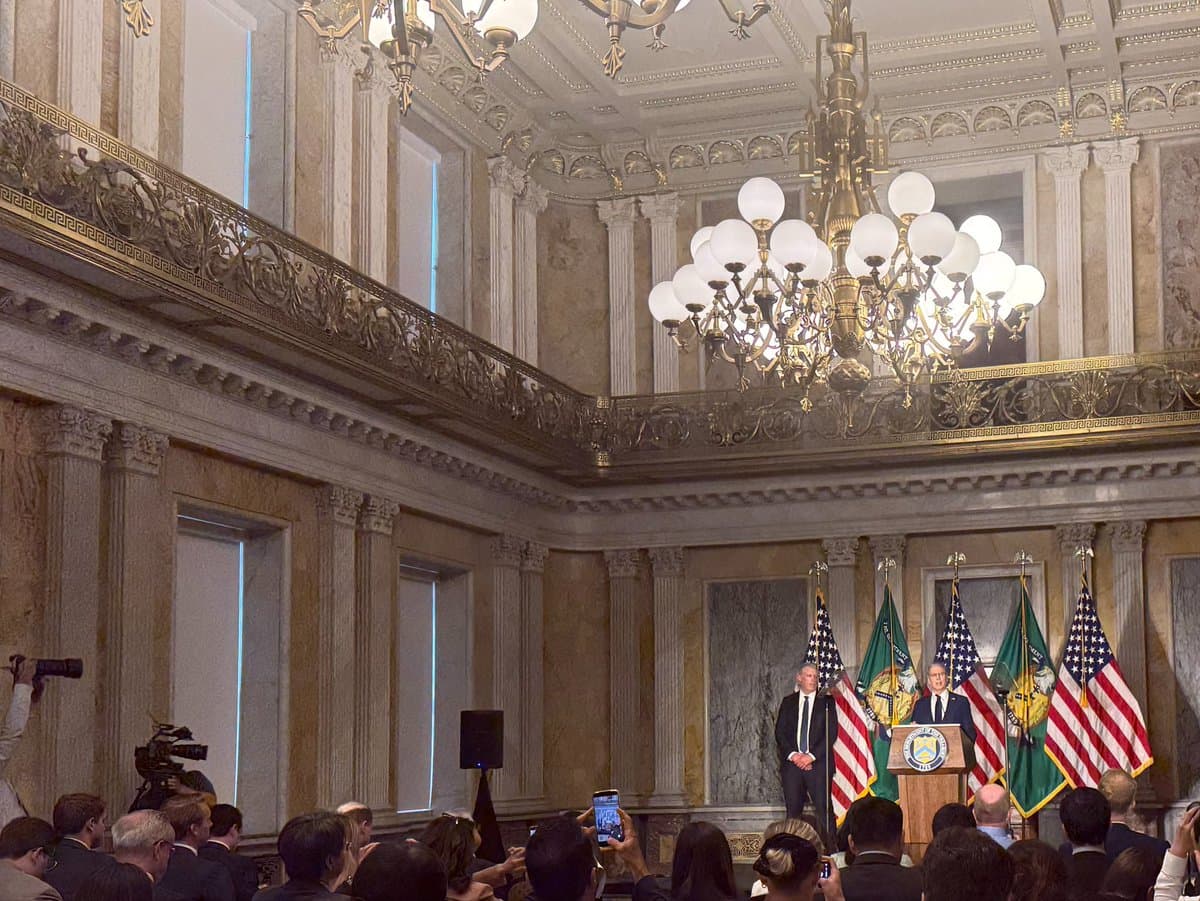
Treasury Secretary Scott Bessent described the campaign as an economic equivalent of D-Day. In remarks prepared for delivery, he said the goal is to leave Tehran standing alone by closing every financial channel that has allowed the regime to fund its nuclear programme, missile development, cyber operations and regional activities.
The measures expand secondary sanctions risk across five sectors that Iran has used to generate income and procure restricted technology: digital assets, technology, gold, aviation and shipping. Any entity that continues business in these areas with Iran now faces accelerated exposure to U.S. penalties, including removal from the dollar system.
On the same day the Office of Foreign Assets Control sanctioned nearly 60 entities, individuals and vessels located in multiple jurisdictions. The targets include networks accused of enabling oil revenue generation, illicit nuclear and missile technology procurement, and cyber operations. Bessent stated that Treasury has already mapped every node and facilitator Iran has used to smuggle oil and evade earlier restrictions.
Countries and companies still dealing with Iran received a clear timeline to shut down identified activities. Failure to act will trigger unilateral U.S. measures. One concrete example given was the requirement that every branch of Bank Melli must be closed.
The announcement comes after months of heightened military and economic confrontation. Iran has faced a naval presence near its ports and a series of earlier sanctions. Bessent framed the new operation as the endgame once military pressure had already weakened Iran’s conventional capabilities and constrained its nuclear programme.
India, which continues to import some Iranian oil under existing arrangements, was among the trading partners warned in broader U.S. statements about consequences for continued commercial ties. The secondary sanctions mechanism is intended to force a binary choice: compliance with U.S. pressure or acceptance of financial isolation.
Iran’s currency has already fallen to record lows against the dollar. Officials in Washington present the new campaign as the means to accelerate that decline until the regime’s remaining external support collapses.
Whether the secondary sanctions will produce rapid changes in third-country behaviour remains open. Previous rounds of pressure have left residual trade corridors intact. The expanded sectoral determinations and the speed of enforcement will determine how quickly those corridors close.
Continue reading
 Geopolitics
EU Imports Record 12.18 Million Tonnes of Russian Arctic LNG Worth €7.88 Billion
Almanaque Digital DeskBrussels
- News
Landslide-Triggered Flood Sweeps Houses and Bridges on Nepal’s Budhi Gandaki
Almanaque Digital DeskGorkha, Nepal
- News
RSF Drone Strike Kills at Least 30 Near Displacement Camp in Sudan’s Blue Nile