Two men pulled alive from a Nepal hydropower tunnel nine days after the glacier flood
Sanjay Sah and Kabir Maharjan were lifted from the Upper Trishuli 3A tunnel on 4 September. Rescuers heard voices at about 170 metres. A third worker was found dead. More than 40 others were thought to remain inside.

Rasuwa4 min read
Last updated
On Friday morning, 4 September, two mud-caked men were pulled through a hole in the ground at the Upper Trishuli 3A hydropower project in Rasuwa district. They had been underground for nine days.
Sanjay Sah, 30, a mechanical foreman from Saptari, came out first. Kabir Maharjan, 45, a mechanical supervisor from Kathmandu, followed. Both work for the Nepal Electricity Authority. Videos released by the army show Maharjan being hoisted on a line as people on the bank cheer, then Sah being carried on a worker's back, his face still coated in silt. Army doctors fitted an oxygen mask in a tent before both men were flown from an army base in Nuwakot to the Army Hospital in Kathmandu.
Brig. Gen. Raja Ram Basnet, the army spokesman, said the pair were recovered from a depth of about 170 metres inside the tunnel. Lt. Col. Ganga Baral, one of the officers leading the crawl, said the team had called into the dark: "We are coming. Don't worry, the Nepali Army is coming." An engineer on site, Shri Ram Neupane, said rescuers heard a reply of "Okay" before they reached the men.
Maharjan cannot move his hands or legs and was listed as critical by the Prime Minister's Office. An aide to Energy Minister Biraj Bhakta Shrestha told Reuters that Sah's injuries were not considered critical. Dirghayu Kumar Shrestha, head of the Nepal Electricity Authority, said the body of a third man, a mechanical engineer, was also recovered on Friday.
Sah later told India Today that he had kept repeating the Hare Krishna mantra through the wait. He also told briefers that more than 40 other workers had been inside the same tunnel when the flood hit. Rescuers said they heard other voices during the approach, then lost them. Amrit Thapa, a deputy superintendent of the Armed Police Force on the seven-person search team, said the group crawled 10 to 15 metres to the main section, found one body on an upper level, and that except for two sections the tunnel was packed with debris. After a full check they heard no further voices.
How the men were still there
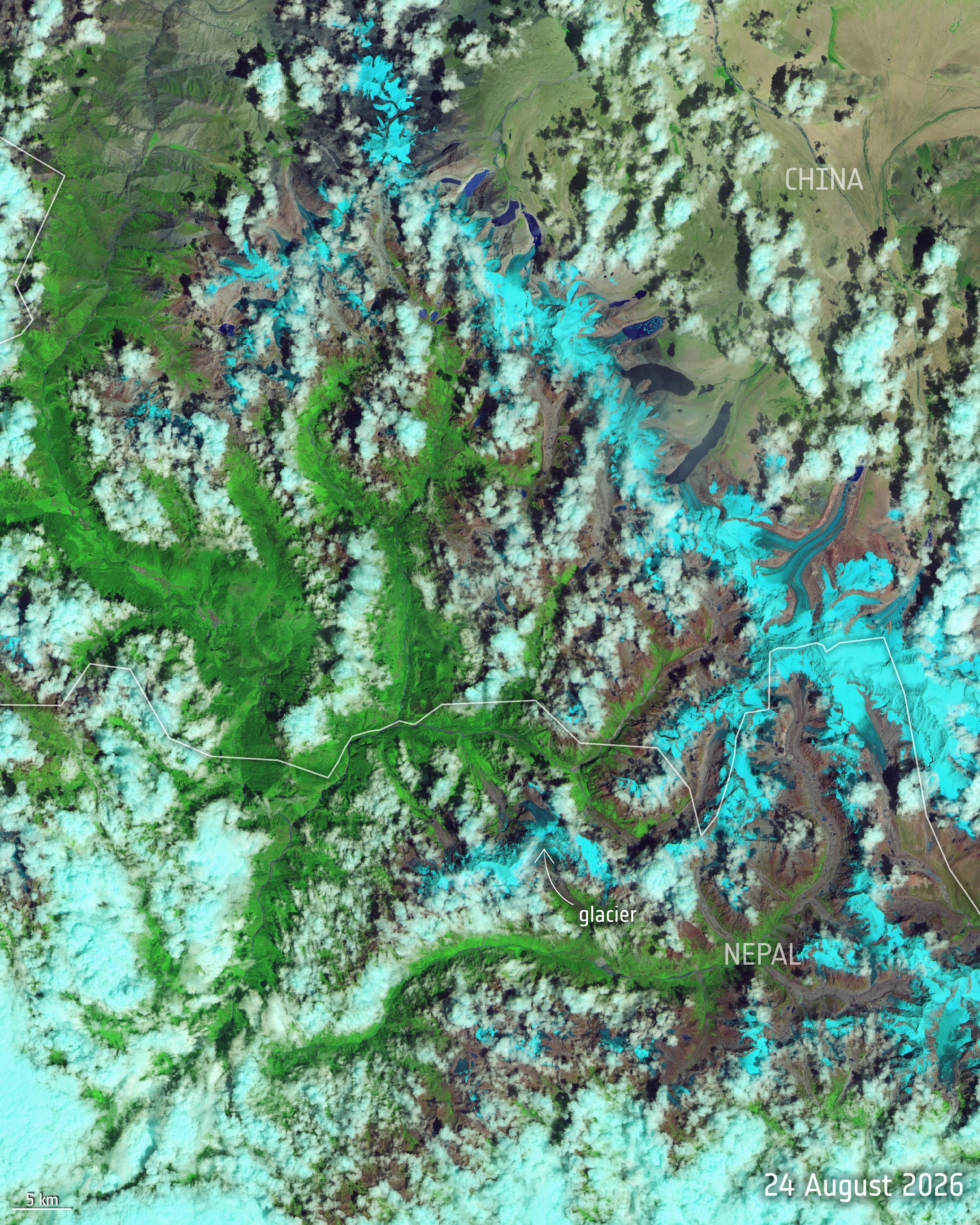
The flood began on the morning of 26 August, when a section of glacier on Langtang Lirung in Langtang National Park failed. Geologists working from satellite frames described an ice-and-rock mass about 600 metres wide falling roughly 1,200 metres into the Lende Khola. The United States Geological Survey first logged a magnitude 4.4 event, then revised it to a magnitude 5.2 glacier collapse and debris flow rather than an earthquake. Water on the Trishuli rose by as much as nine metres in half an hour in some reaches. Britannica later put the surge inside high gorges at tens of metres above normal.
The slurry of ice, rock and mud travelled tens of kilometres down the Trishuli, wrecked the Gyirong border post with China, and buried hydropower works that had been cut into the valley walls. Nepal's hydro industry sits on those tunnels. Officials said at least 900 people were unaccounted for across tunnels tied to about six projects after operators submitted their lists. At Trishuli 3A alone the search focused on 42 missing workers.
It took almost six days for teams even to locate the tunnels under the new ground. On Saturday 29 August the army said two thermal drones had not picked up life signs, but the search continued. That night Home Minister Sudan Gurung said rescuers had reached the crown of the Trishuli 3A tunnel and had started pumping air through the hole while they dug. Technical teams from India and China worked with the Nepali Army and police.
Andrew Dix, an Australian engineer advising the effort, used old drawings, satellite images and charts to look for what he called "Goldilocks zones": small underground pockets where a person might still have air and space. Friday's find was the first live recovery from any of the hydropower tunnels.
What the numbers still say
By 4 September the combined death toll in Nepal and Tibet stood above 1,300, with several thousand still listed missing. Chinese officials put the Tibet count at 31 dead and 531 missing in Gyirong county. India's Ministry of External Affairs said 275 Indian nationals remained untraced and 166 had been rescued. Some bodies were carried as far as 240 kilometres into India on the river.
The two men do not close the search. Hundreds of workers were inside those galleries when the wave arrived. The army has already said it will keep cutting. Sah's account that dozens were with him in one heading is now the working map for the next shift.
Hydropower is a large share of Nepal's electricity and export plan. The same geology that makes the rivers useful also puts the plants on the runout of ice and rock from the high catchments. Friday's rescue shows that a person can live nine days in a sealed heading after a glacial collapse. It also shows how little margin those tunnels leave when the mountain above them moves.
Continue reading
 News
NewsCrew-13 lifts off at 11:10 a.m. with a docking aimed at the fastest US arrival
Almanaque Digital DeskCape Canaveral
- News
Datafolha puts Lula four points ahead of Flavio Bolsonaro, and the runoff inside the margin
Almanaque Digital DeskSao Paulo
- News
Chinese refiners hold October fuel exports, and Singapore diesel jumps then fades