Rajendra Dawadi rang the bell and sent 900 students uphill before the Trishuli took the school
The 47-year-old principal of Tribhuvan Trishuli Secondary School in Nuwakot had minutes after an upstream village vanished. Two staff members are still missing. The building he once studied in is gone.

Nuwakot3 min read
Last updated
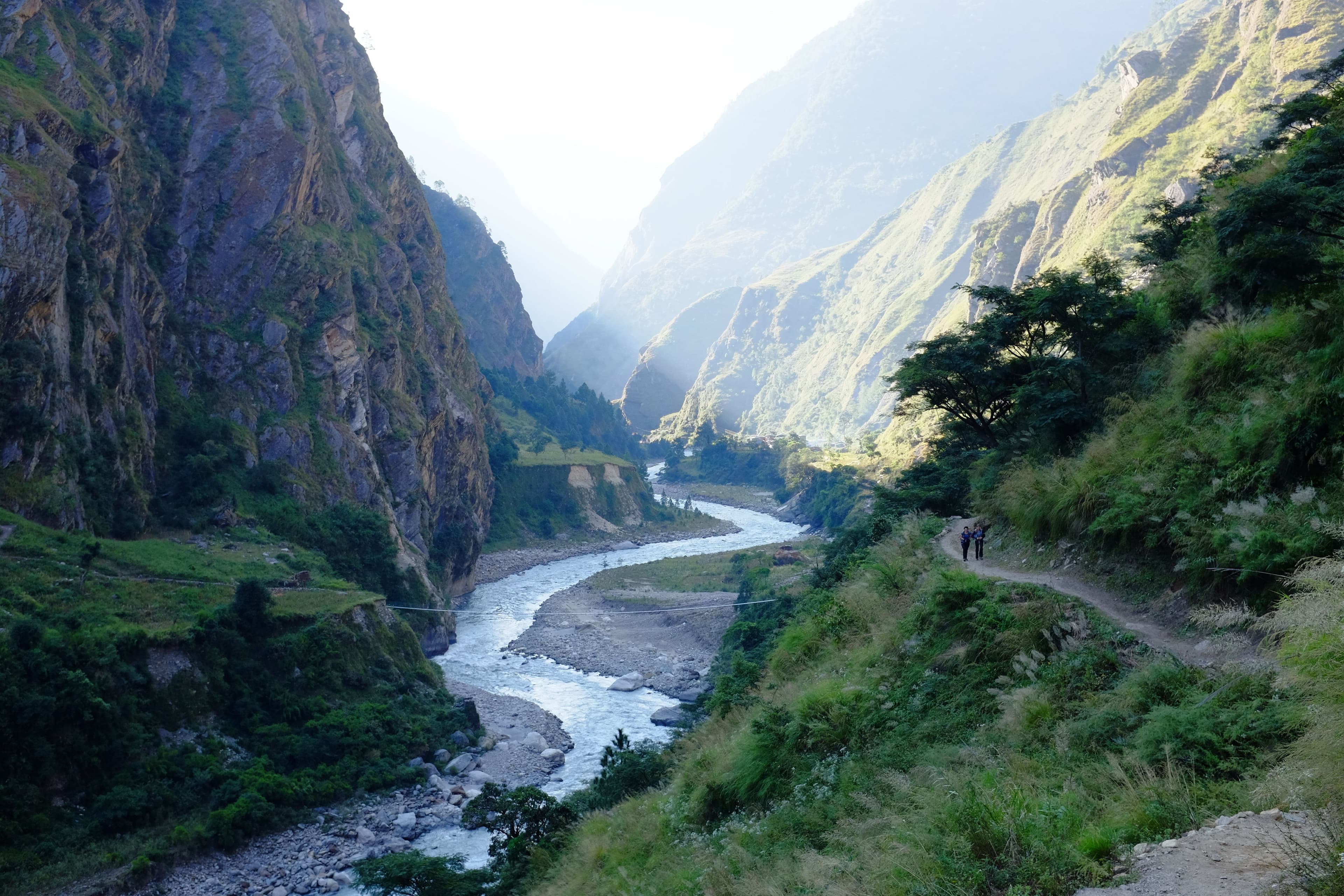
Rajendra Dawadi was in a classroom at Tribhuvan Trishuli Secondary School when a colleague ran in with the first warning. Floodwater was coming down the Trishuli Valley. A second warning arrived by phone. A parent appeared to take a child home. Dawadi, 47, the principal and English teacher, rang the school bell and ordered everyone out and uphill.
About 900 of the school's 1,643 students were on campus that morning, mostly aged 11 to 18. He told those whose houses were safe to go home and those whose houses sat near the river to climb. Teachers ran with the children. Dawadi stayed in the rooms long enough to send the gatekeeper and the guard out with whistles. He called bus drivers and told them to turn back. One loaded bus had already reached the school. He sent it away. Another bus he could not reach had already crossed the river bridge. He later flagged a driver on the approach and made him reverse.
From the hillside he watched the building go. He had studied in it and taught in it. Water, mud, boulders and timber took the rooms. Two staff members did not reach high ground and remain missing. Social history teacher Santos Pariyar, 32, was washed away after going back to a rented room beside the river to cook breakfast, according to later accounts from colleagues. The children who made the hill waited under a bodhi tree.
Fourteen minutes
Dawadi has told NDTV and AP that the first warning landed around 9:20 a.m. on 26 August, when a friend said a village upstream was gone and told him to run. The flood reached the town about 14 minutes after that first call. That is the whole decision window. There was no official siren he could wait for. There was a colleague, a phone, a parent at the gate, and a principal who treated an unconfirmed rumour as an order to empty the school.
The Himalayan flood of 26 August began with a glacial collapse on the China-Nepal border. Nepal's recovered-body count passed 1,000 by 1 September. Thousands remain missing. Hydropower tunnels still hold people the search teams have not reached. Dawadi's school is one building in that larger wreck. It is also the rare file in which a named person made a timed choice that can be checked against the water.
He did not get every child off the road. The bus that had already crossed the bridge is the sentence that sits beside the 900. The two missing staff members are the other sentence. A clean hero story would drop both. The useful story keeps them. An evacuation that saves hundreds can still lose the people who go back for a stove or who are already on the wrong side of a bridge.
What the hillside does not settle
Prime Minister Balendra Shah, 36, now has to turn a youth mandate against graft into a reconstruction plan measured in billions of dollars. Foreign teams, including a 13-member American group from Crisis Response International, have reached the Chilime tunnels. South Korea has said it will send 44 relief workers. Those deployments will be judged by bodies recovered and by whether any living person comes out of a tunnel. Dawadi will be judged by a simpler record: the bell, the hill, the missing colleagues, and a school that is no longer there.
The next term in Nuwakot will start in rooms that have not been built. The 900 students who climbed are the reason that sentence is about rooms rather than funerals. The two staff names are the reason it cannot be read as a complete rescue.
Continue reading
 News
NewsEthiopia orders an Egyptian diplomat out within 48 hours as it shuts the Asmara embassy
Almanaque Digital DeskAddis Ababa
- Geopolitics
Greer says an India trade deal is in the short strokes and nothing is imminent
Almanaque Digital DeskMilwaukee
- News
England and Wales free about 700 prisoners on the first morning of the Sentencing Act scheme