NASA's Roman telescope leaves Pad 39A for a million-mile post at L2
A Falcon Heavy lifted the $4.3 billion Nancy Grace Roman Space Telescope at 7:26 a.m. Eastern on 30 August. Goddard locked telemetry in seven minutes. First public images are due in early 2027.

Kennedy Space Center3 min read
Last updated
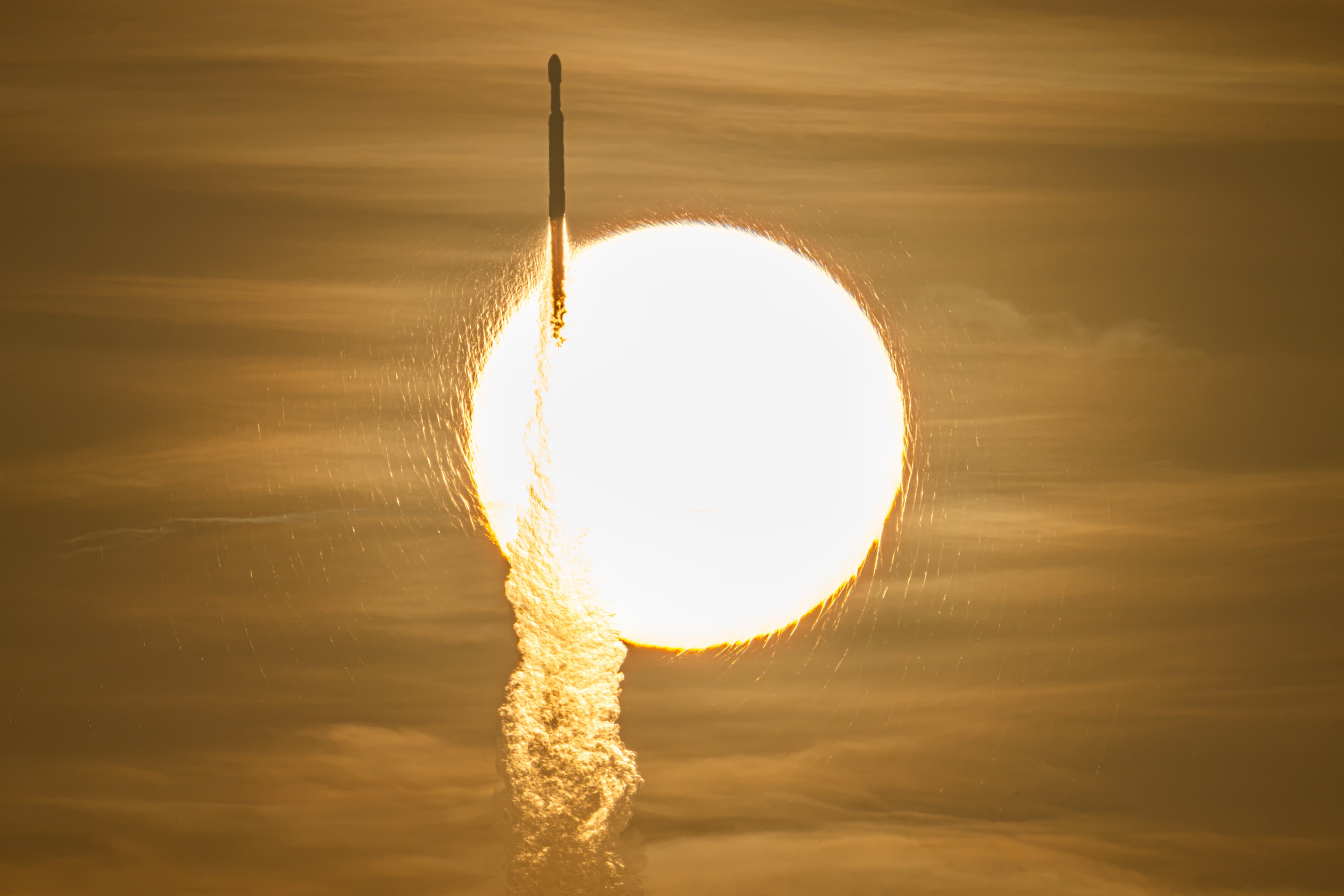
A SpaceX Falcon Heavy left Launch Complex 39A at 7:26 a.m. Eastern on 30 August with NASA's Nancy Grace Roman Space Telescope on the upper stage. The $4.3 billion observatory is now on a three-month run to the Sun-Earth L2 point, about one million miles from Earth, the same neighbourhood occupied by the James Webb Space Telescope.
Goddard Space Flight Center in Greenbelt, Maryland, locked telemetry seven minutes after liftoff. The core stage separated from the spacecraft at 31 minutes. The two side boosters flew back to Landing Zones 2 and 40 at Cape Canaveral. An hour and 23 minutes after launch, the team confirmed that the solar arrays and the lower instrument sun shade had opened. High-gain antenna and aperture cover deployments are scheduled in the days ahead.
Roman is NASA's first flagship astrophysics mission since Webb. The 2.4-metre primary mirror matches Hubble's diameter. The difference is the camera behind it. The Wide Field Instrument is a 300-megapixel infrared imager built from 18 detectors, each about the size of a saltine cracker. NASA says a single Roman frame will cover a patch of sky 100 times larger than a Hubble image at comparable sharpness. The agency's planning documents put the survey speed at about 1,000 times Hubble's.
That field of view is the point of the mission. Roman is built to map dark energy and dark matter by measuring the shapes and distances of billions of galaxies, to find exoplanets by gravitational microlensing, and to run a wide infrared census that Hubble and Webb cannot finish on any practical calendar. The spacecraft is expected to send 1.4 terabytes of data back to Earth every day, the highest daily rate of any NASA astrophysics mission so far.
A second instrument, the Coronagraph, is a technology demonstration designed at the Jet Propulsion Laboratory. It is meant to suppress starlight well enough to photograph planets around other stars. NASA plans to power the Coronagraph on in the coming days. The Wide Field Instrument stays off for a few weeks while the spacecraft cools and settles on the cruise.
NASA Administrator Jared Isaacman called the launch a case of delivery ahead of schedule and on budget after more than a decade of work. Nicky Fox, associate administrator for the Science Mission Directorate, said the survey speed is what will let the mission "make the invisible visible." Julie McEnery, the senior project scientist at Goddard, put the claim more simply: astronomers have not had eyes like these before, and the first year of operations will decide what that sentence is worth.
The hardware itself is a converted story. Roman's optical system grew out of a surplus National Reconnaissance Office telescope that NASA accepted more than a decade ago. Goddard was the prime integrator. The launch vehicle contract went to SpaceX under NASA Launch Services. This was the fourth primary NASA payload to fly on a Falcon Heavy.
Commissioning lasts about 90 days. Engineers will calibrate the pointing, the thermal control and the detectors on the way to L2. Project manager Jackie Townsend has said the team wants the first high-resolution frames before the winter holidays, with a public release targeted for early 2027. Until then the spacecraft will hand off between Deep Space Network stations in Australia, Spain and California.
The scientific programme is already booked. The High Latitude Wide Area Survey will measure weak gravitational lensing across a large slice of the sky. The High Latitude Time Domain Survey will watch the same fields repeatedly to catch Type Ia supernovae at distances that constrain how fast the universe's expansion has changed. A Galactic Bulge Time Domain Survey will stare toward the centre of the Milky Way to catch microlensing events from planets that do not transit their stars. Guest observer time sits on top of those core programmes.
Roman does not replace Webb or Hubble. Webb is a deep, narrow observatory. Hubble still owns the ultraviolet. Roman is the mapper. The three together give astronomers a way to find a target in a wide field and then stare at it with a different instrument. That is the concrete change this launch makes to the next decade of observational astronomy.
The spacecraft still has to survive the cruise, the insertion into a halo orbit around L2, and the first weeks of detector checkout. Those steps are routine on paper and unforgiving in practice. If they hold, the first public frames in 2027 will show whether the camera does what the design review promised: a Hubble-class image, only a hundred times wider, arriving every day.
Continue reading
 News
NewsCrew-13 lifts off at 11:10 a.m. with a docking aimed at the fastest US arrival
Almanaque Digital DeskCape Canaveral
- News
Datafolha puts Lula four points ahead of Flavio Bolsonaro, and the runoff inside the margin
Almanaque Digital DeskSao Paulo
- News
Chinese refiners hold October fuel exports, and Singapore diesel jumps then fades