
Chinese humanoid robot clocks 9.39 seconds in 100 metres, faster than Usain Bolt record
Tiangong Ultra from the Beijing Humanoid Robot Innovation Center finished ahead of Honor's Lightning in a preliminary heat at the World Humanoid Robot Games.

Beijing1 min read
Last updated
A humanoid robot named Tiangong Ultra ran 100 metres in 9.39 seconds on Saturday in Beijing, beating the human world record of 9.58 seconds set by Usain Bolt in 2009.
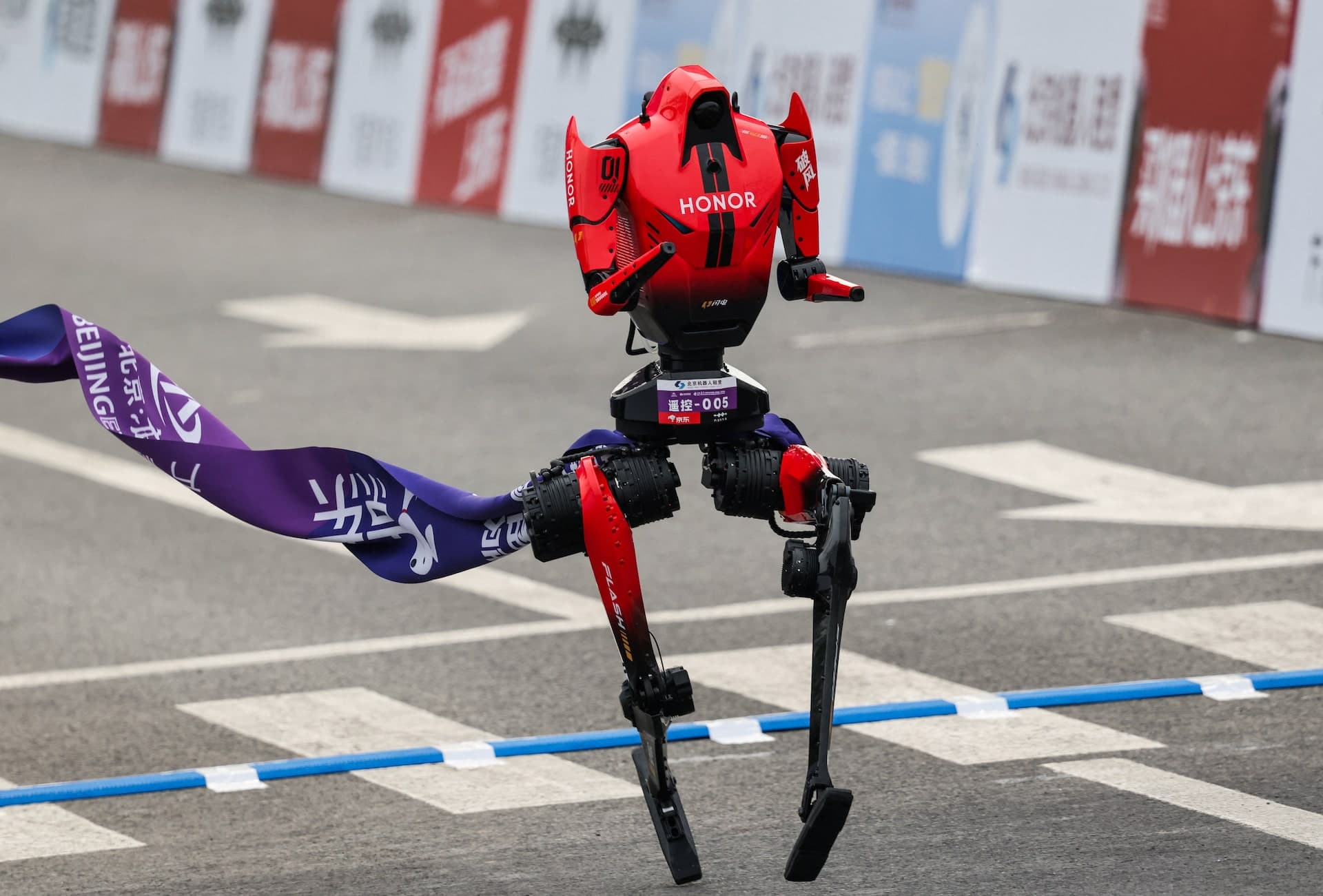
The robot, built by the Beijing Humanoid Robot Innovation Center, won its heat at the opening of the second World Humanoid Robot Games. Honor's Lightning robot took second place in 9.47 seconds. Both times beat Bolt's mark from the World Athletics Championships in Berlin.
Tiangong Ultra started behind Lightning but overtook it near the finish. The robots then ran straight into a thick mat set up to stop them. Tiangong stumbled into the sidelines. Lightning collapsed and was carried away on a stretcher.
Organisers said more than 2,000 robots from 666 teams across 16 countries are competing in 51 events that include football, dancing and industrial tasks. The games run through Wednesday at Beijing's National Speed Skating Oval.
Last year, at the inaugural games, Tiangong Ultra won the same event in 21.50 seconds. It also won the first humanoid robot half-marathon held in Beijing. Lightning improved its own half-marathon time this year to 50 minutes 26 seconds.
Earlier on Saturday, state media reported Lightning had run 100 metres in 9.32 seconds in a test, reaching a peak speed of 14.5 metres per second. Researchers lengthened its legs by 10 centimetres to 1.05 metres ahead of the games. The robot stands 169 centimetres tall.
China treats humanoid robots as a strategic industry. Policymakers and companies expect advances in artificial intelligence and hardware to speed their use in manufacturing, logistics and consumer settings. Shares in Unitree, a leading Chinese humanoid robot maker, jumped more than fivefold on its Shanghai debut earlier this week, giving the company a market value near 50 billion dollars.
The results show clear progress in locomotion control and power systems. Whether the same machines can handle uneven ground, obstacles or long-term reliability remains an open question that the remaining events may begin to answer.
Continue reading
 News
NewsRussian double drone strike on Kryvyi Rih shopping mall kills 16, injures 130
Almanaque Digital DeskKryvyi Rih
- News
Magnitude 5.9 earthquake shakes eastern Japan including Tokyo; dozens injured
Almanaque Digital DeskTokyo
- Geopolitics
US-Canada trade talks collapse; 50 percent tariffs take effect, Canada prepares dollar-for-dollar response