A 96% lunar eclipse falls on Raksha Bandhan, below India’s horizon
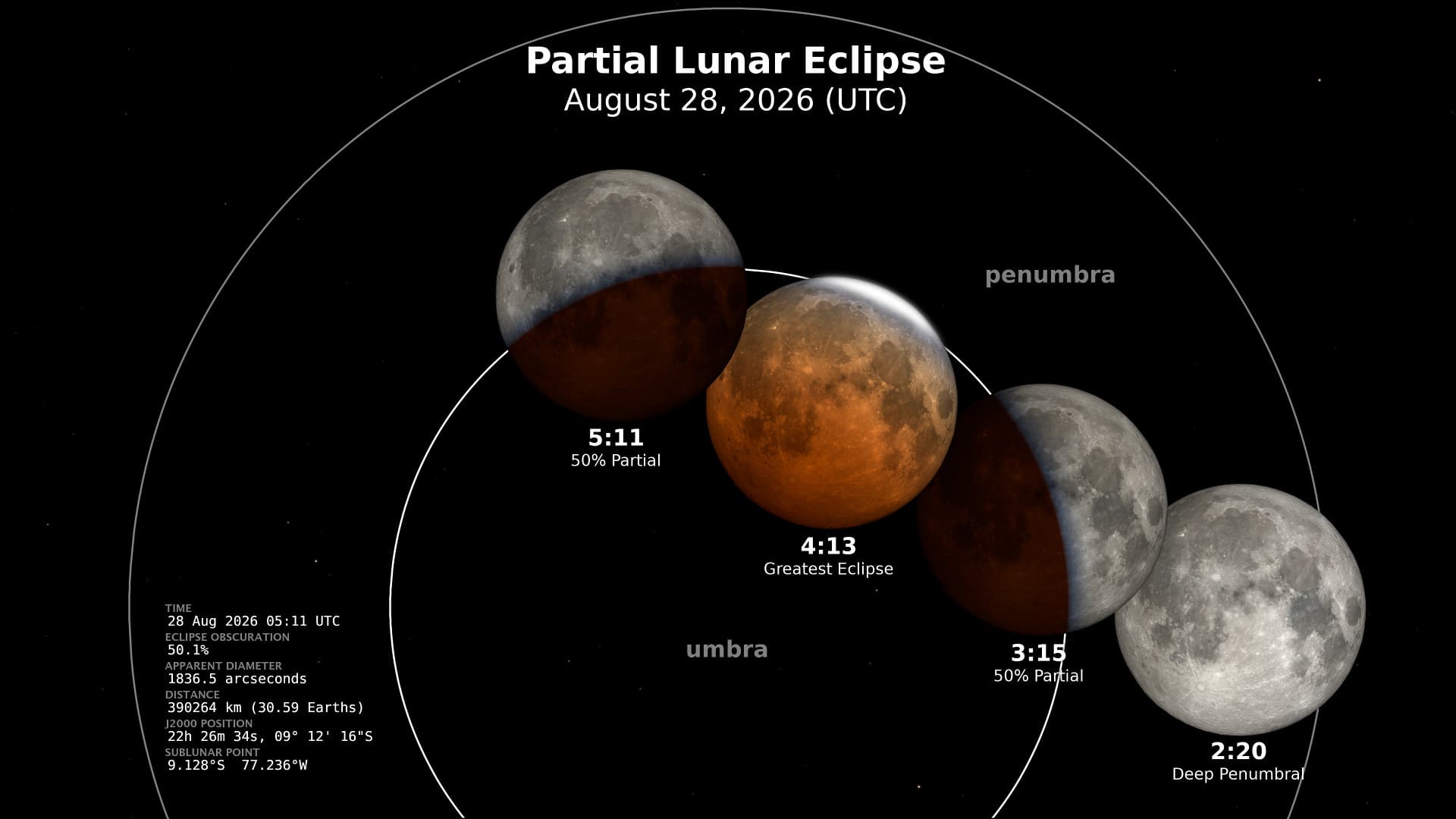
NASA puts greatest eclipse at 04:13 UTC on 28 August, with 96.3% of the Moon inside Earth’s umbra. In IST the partial phase runs from 8:04 a.m. to 11:21 a.m. The Moon is down across India, so Panchang guides say Sutak does not apply and the morning Rakhi window stands.

New Delhi3 min read
Last updated
Friday, 28 August, packs two clocks into one morning in India. It is Raksha Bandhan. It is also a deep partial lunar eclipse that will cover 96.3 percent of the Moon at peak. The second event will not be visible from the country, because the Moon will already be below the horizon.
NASA’s Scientific Visualization Studio puts greatest eclipse at 04:13 Universal Time. That is 9:43 a.m. in India. The partial, umbral phase begins at 02:34 UTC, 8:04 a.m. IST, and ends at 11:21 a.m. IST. The faint penumbral shading starts at 6:55 a.m. IST and fades by 12:30 p.m. At maximum, only a sliver of the disk stays in sunlight. Observers in the Americas, western Europe and western Africa will see the rest of the Moon turn copper.
Purnima tithi, the full-moon day that governs Rakhi, runs until 9:48 a.m. IST on the 28th. In New Delhi the commonly cited muhurat for tying the thread is 5:57 a.m. to 9:48 a.m. Drik Panchang and other widely used almanacs say Sutak, the ritual restriction that accompanies a locally visible eclipse, does not apply when the eclipse cannot be seen from the city.
Why the sky and the festival collided
Raksha Bandhan follows the lunar calendar. Eclipses follow orbits. A full moon is the only time a lunar eclipse can happen, so the overlap is geometry, not an omen invented for the week. The unusual part is the depth. NASA calls it a deep partial: 96.3 percent of the disk inside the umbra is close enough to a total eclipse that the shadowed face should show the red scatter of sunlight bent through Earth’s air.
India simply faces the wrong way at that hour. The Moon has set. Families who want the picture will watch a foreign feed. Families who want the ritual have a morning window that ends when Purnima ends, at 9:48 a.m. in the capital, with local Panchang times shifting by minutes across the country.
Some calendars still printed 27 August because the tithi begins that morning, at 9:08 a.m. on the 27th. The festival follows the sunrise tithi. Priests who settle these arguments have already pointed at the 28th.
What Sutak is, and what it is not
Sutak is a set of customary pauses around a visible eclipse: no new cooked food, no temple visit, no thread ceremony until the shadow lifts. Those pauses are tied, in the guides now circulating, to visibility at the place of the observer. A daylight eclipse underfoot in New York does not put Delhi in Sutak.
Households that keep stricter family rules can still wait. The public line from the main Panchang publishers is that they do not have to. State transport departments have already treated Friday as a festival day. Uttar Pradesh is running free bus travel for women across the Rakhi night. Odisha has rain warnings that may close some schools on the same date. The eclipse is not the variable in those orders. The full moon and the monsoon are.
For anyone standing in Brazil or Spain before dawn, the show is the Moon with a bite that keeps growing until only a rim is left white. For anyone standing in India, the show is a thread, a morning deadline, and a NASA map of an event happening under their feet.